
In 1984, I qualified as one of the fastest 200 marathon runners in the USA. The finish time necessary for qualification for the inaugural women’s Olympic Marathon Trials forty-years ago was 2 hours 51 minutes, or 6 minutes 31 seconds a mile pace. The Olympic Marathon Trials was an epic event - the first time women were allowed to run the 26.2 mile distance in the Olympic Games.
To meet the qualifying time, I wore the first wearable device that was ever invented, a heart rate monitor. At that time, I paid $450 for this a little known or respected performance tool. Today’s value for $450 is calculated is $1,400 - that was a lot of money for a performance enhancement tool that only showed me one data point - the beats per minute of my heart in real time as I raced.
I realized at the time that a heart rate monitor was clearly the most important exercise equipment invention of the 20th century. Much more significant than any exercise machine – any treadmill, exercise bike, stepper, rower or other exercise equipment for that matter. I fell in love with this magical tool that guided me to running a PR (personal record), repeatedly.
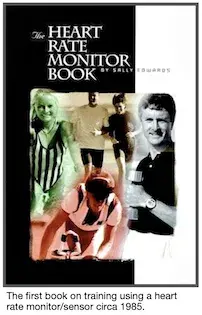
The following year, 1985, I wrote the first book on training using a heart rate monitor, coinage “zone training.” Zone training is a method that divides data points into context ranges like Zone 3, the Yellow Zone (for me 120-140 bpm) moderate exercise intensity. Today’s wearable tech companies base their heart rate zone colors, zone metabolic weight, and zone point calculation on the zone training methodology that I created four decades ago. Credit? None yet. This book that was in such popular demand is titled The Heart Rate Monitor Guidebook and sold more than one million copies. It was published in a dozen languages by Polar Electro Oy in Finland. And, Polar, a manufacturer of heart rate monitors refused to pay me the royalties owed by publishing contract. More than disappointing as you can imagine.
Fast forward 40 years, and the wearables space has evolved. The creation of the heart rate monitor as the first biosensing device was slow to gain popularity. Today, I am pleased to see that the measurement and monitoring of our own well-being gradually becoming popular giving you all the ability to heart rate train with individualization and personalization. The heart rate monitor is so important that nine times in the last twenty years, wearables have been the #1 fitness trend according to the ACSM, American College of Sports Medicine.
The popularity of biometric tools has also led to confusion for many participants, possibly for you too. For example, do you question the reliability of the algorithms, do you question what the data means, and, most importantly for a consumer, question what is the best option to suit your needs and our wallet? Whom and where do you turn to in order to make an educated purchase decision? Do you believe that device manufacturers of these devices are evens slightly qualified to give you health and exercise prescriptions or analysis of the data? Do you trust manufacturers, engineers, app developers to give you analysis? Or do you put your trust in health and exercise professionals?
Personally, today, but this may change, I still prefer my Apple Watch as a biometric sensor, although I was a big Garmin fan before. I keep testing new wearables released into the market always on the hunt for a better or different health and fitness management solution. Recently, I tested a brand-new Chinese wearable from a publicly traded New York stock exchange company: Zepp Health. I tested their wearable wrist device called the Amazfit Bip 6. It looks exactly like the Apple Watch (hmmmm think copycat) but comes with additional activities and measurements: (1) health measurements: heart rate, sleep analysis, stress analysis, blood oxygen levels, and others; (2) training recommendations paid yearly; (3) other features: phone, music, weather, calendar, map, and others. Cost: $80. Meanwhile, the Apple Watch, which has many of the same features, can cost $250-$700. There’s something strange about this enormous price difference between these two wrist wearables which makes one wonder the why question - why is there such a big difference in price?
There is a lot to consider if you are a wearable enthusiast about which lifestyle monitoring tool fits your needs such as accuracy, compatibility, data access, the subscription trap, repairability, eco-system lock-in, data portability, and so much more. It all matters.
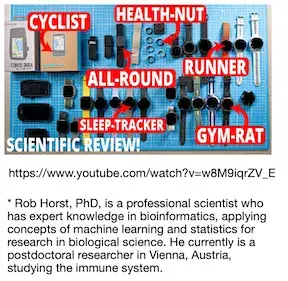
As I tested my new heart rate monitor from Zepp, I learned of a new reviewer resource, a quantified self-science YouTube channeler from the Netherlands, a scientist by the name of Rob Horst, PhD. Rob now has over 366,000 subscribers and 310 videos in his channel called “The Quantified Scientist”. Rob’s opinions are not for sale. He purchases his wearables so no sponsorship. Rather, he basesall of his recommendations on his real testing results, comparing dozens and dozens of different wearable devices. So, if you’re considering a new wearable, you might want to subscribe to his channel, “The Quantified Scientist,” because his reviews go in-depth, not just opinions or superficial reviews of wearable technology. One of his most recent reviews is here.
I’ve listened to many so-called ‘experts’ over the last four decades and been misled by many who have fee-based sponsor bias, using marketing speak like “proprietary algorithms” and long-term durability that I simply don’t trust their recommendations.
Among the motives for my writing this blog post, I am trying to encourage you to snag a wearable considering these two options: (1) buy your first wearable device or start using the one that you have or (2) upgrade what you are currently using. Rob Horst’s advice is free as he is there for the user not to sell you anything.
The evolution of wearable technology reflects my own journey: from pro athlete, to early adopter of data-driven training, to coach-teacher, to author of seminal books on the application of exercise science to physical activity and weight loss. And, as the fit-tech evolves, so do I.