
History:
Heart rate monitors have gone through five different evolutionary periods. With each new period, as they evolved, they have add more functions, better navigational UIs (user interfaces), and improved data with personalization plus prescription.
Forty years ago, I created the first heart rate training methodology. Back in 1992, I published the first and the seminal book on how to train with a heart rate monitor. In those early days, there was just one manufacturer. There were about as many fitness enthusiasts who, like me, feel in love with this new communication device or those willing to listen to their heartbeat. Today, there are now millions who love and use the beat of their hearts. Likewise, instead of one manufacturer of this device, there are over 30 to choose from now.
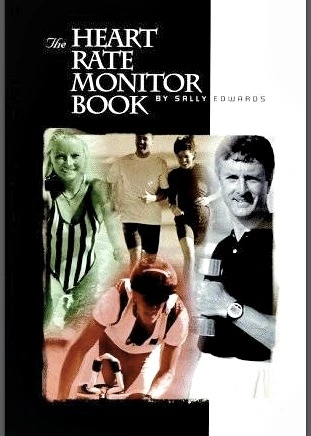
Of those five different evolutionary periods, I have weathered them all. I have the distinct advantage of serving as both a pioneer enthusiast and then as the original innovator of zone training, the first methodology applied to using heart rate monitors. The zone training methodology that almost all mobile apps and monitors use today typically feature either a 3 or a 5 zone method. I originally created both starting with the 5-zone maximum heart rate method when I wrote the first book on training titled The Heart Rate Monitor Book.
At the time, my chain of retail running stores aka Fleet Feet, as it turns 50 year old this year, sold the original one and only model available at the time for around $450. (Note: $450 a half century ago is well over a $1,000 today). Sure, they were expensive but incredibly valuable, especially for professional athletes, if you knew how to train using a biometric device like this. Currently this powerful wearable bio-metric sensor is used in different channels such as schools, health clubs, healthcare, first responders, weight-loss, and for competitive athletes like myself.
Period 1: 1978 - The first wired heart rate monitor
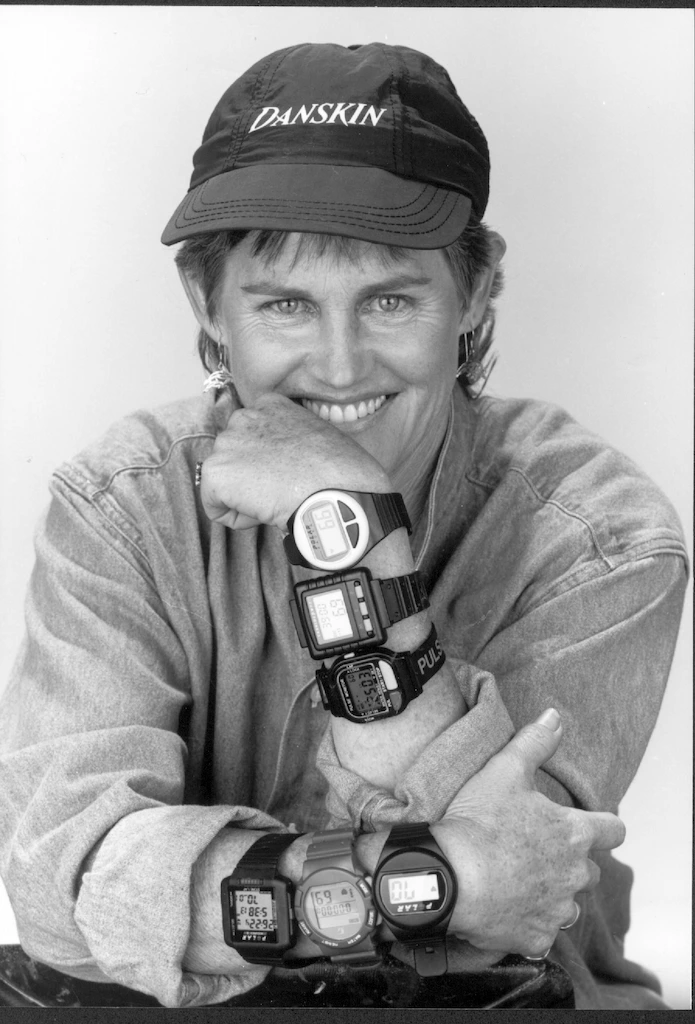
The first heart rate monitor was hard wired not wireless like today. Marketed by the Finnish exercise equipment company Tunturi, it was called the Pulser. The Tunturi Pulser was the first portable hard-wired device with a chest-strap. In 1978, there was no watch or mobile smart phone for an interface and display. I started to train with a heart rate monitor that same year and right away I was hooked. Over the next four decades, as the picture of me below, I have tested so many different models and manufacturers that I became affectionately known as the “Queen of Hearts”.
With my graduate degree in exercise science from UC Berkeley, I knew that a heart rate tool would help my running and later triathlon racing. My graduate thesis was interestingly about where muscle fatigue originates in the human body. If we identified the locus of fatigue, we could train better for performance, resilience and endurance. Does the locus of muscle fatigue first occur in the muscle tissue (i.e. the heart or skeletal muscle)? Or was physiological fatigue the result of diminished nerve transmission, or possibly the brain acting like a brake doing it’s job in preventing us from over exertion? As an endurance athlete, I thought the heart rate monitor could help me solve that question.
In the 1970’s, only the truly serious athletes would don this bulky Tunturi Pulser designed by Polar Electro Oy and branded by Tunturi. Prior to the 1980s, we trained by doing the specific sport not preparing for it. This was the fitness era of “to get in shape for a sport, do that sport”. This principle is called “sport specificity.” Basically, the principle of specificity states that to be a good runner you just run and run and run. To be a good basketball player you have to play and play and play. If any of us used structured training: you planned the training, worked the plan, and the plan works.
I authored some of the very first books written on how to train using structure including principles of rest, recovery, measurement, and deep planning with analysis. I introduced in those popular books two new principles neither tested nor endorsed by the exercise science gurus at the time: (1) the principle of zone training and (2) the principle of cross training, a word that I invented and labeled. I did not have access to an exercise lab. At the time, I was running several Fleet Feet retail stores and franchising the company. So, I resorted to real world testing - using myself as the lab rat.
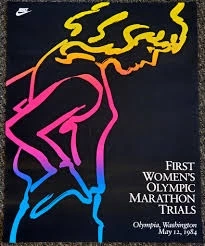
I confirmed that old principles, like the principle of specificity, was incorrect. I demonstrated that by cross training you improve in your single sport; that structured training put the two principles together for success. In 1984, I set a goal: qualify for the Olympic Trials in the first ever marathon. I structured a progressive training load program with 8 weeks of cross training followed by 8 weeks of sports specific marathon-distance training. It worked. I was an Olympic marathon qualifier. As a case study, I applied these two new and central principles of training together. Though this was a single subject design (also known as n=1), I tested the hypothesis that to be a better single sport athlete one must train in multiple sports using heart rate zones. Subsequent research in exercise labs validated this fact.
Period 2: The 1980s - Training with a wireless heart rate monitor
The first wireless heart rate monitor was released by the same Finnish company, Polar Electro Oy in 1983 called the Sport Tester PE 2000. This new wearable, a term derived from the 1980’s reference to “wearable computing”, added a watch to the mix. Using a sensor with EKG-like electrodes that created micro amperes of current which transmitted the heart rate data to a receiver, a wrist receiver. The very low frequency 5kHz analog NFC (near-field communication) signal was intentionally operating at low power levels by design. There were several problems with this transmission protocol but the most annoying to me was error from “cross talk”. Cross talk was the combining of your heart rate monitor number with that of another user when within about 3 feet donning a chest strap.
Taking the guessing out of training intensities, heart rate monitors (and later sensors) gave us accuracy that rate of perceived exertion (RPE) fails at. RPE is based on one’s “feeling” of effort which can be widely inaccurate. This period brought the invention of the first wireless heart rate monitor (circa 1982) leading to a new way of training - using real-time biometric tools providing valuable measurable data. I developed the first method of measuring training load with a heart rate monitor to successfully qualify for the first women’s Olympic Marathon Trials in 1984.
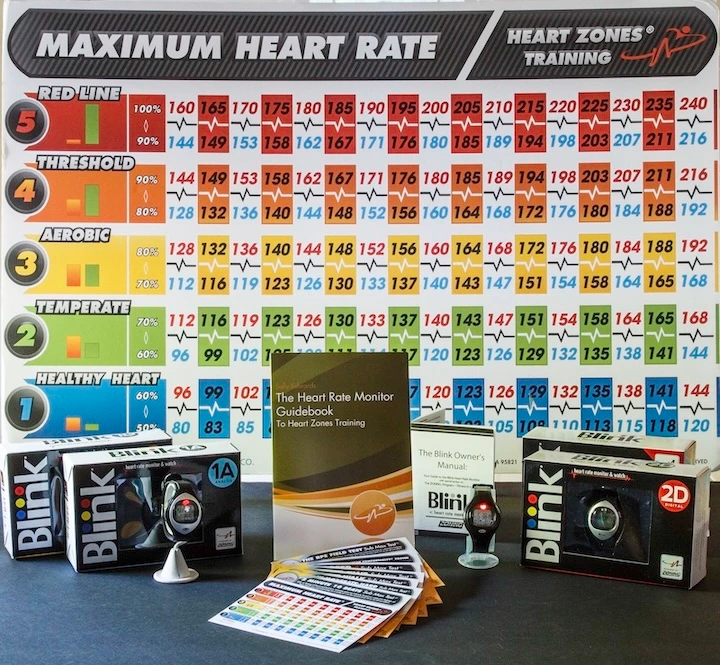
At that time, I wrote the first book on heart rate monitor training. In the past 35 years, I have written a dozen more works explaining to heart rate training enthusiast what the beats-per-minute numbers mean and secondly, exercise prescriptions. I created the term “zone training,” whereby we were able to correlate the heart’s beats per minute (BPM) into for the first-time heart rate zones. Zone training provides context to a whole number.
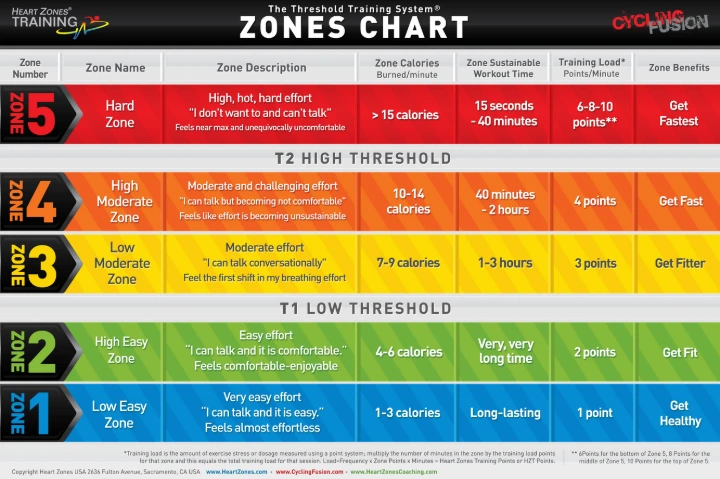
As an example, the heart rate number 120 bpm is often Zone 2, the Green Zone. The five-zone heart rate training chart below was the first to describe what the benefit and outcome of zone training based on each personalized and individualized zone. And sure enough, this same zone methodology can be applied to most fitness and health data concepts from cycling speed and power zones to activity tracking into step zones. Actually, this zone methodology also applies to emotional regulation zones and to food zones.
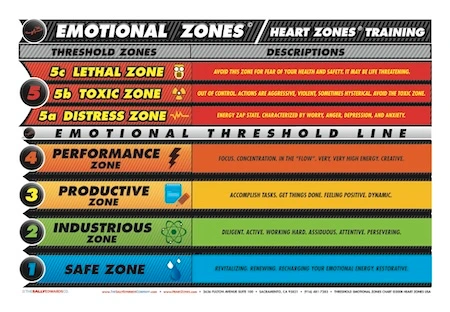
For heart rate training aka "zone training," it was and remains an uphill battle arguing against the “age-adjusted maximum heart rate formula,” or the formula of "220 minus your age". This formula today remains absurd and only accurate for a handful of people. This whacky formula that uses age continues it’s popularity even today, albeit less fervently. I created, with Carl Foster, PhD, past president of the American College of Sports Medicine, the “Threshold Training Method,” for which our company, Heart Zones, deservedly earned the only federally recognized cardio exercise methodology patent. So there!
Period 3: Training in the 1990’s with a wireless heart rate monitor
By the late 1990’s, the wearable evolution begins with the device providing for the first time an exercise prescription. Both the exercise scientists and smart coaches were at this point now starting to tailor exercise to the individual in a new personalized way. To do so, one needed to anchor heart rate zones on a maximum heart rate number. Given that few can reach this number and there is some danger for non-exercisers, the age-predicted maximum heart rate formulas or APMHR resulted in simplicity but dangerous inaccuracies. To counter this challenge, I first created the original field tests for measuring maximum heart rate. One can’t use a math formula to predict most biometrics: cholesterol levels, blood pressure, heart rate, percentage of body fat, and so much more because formulas simply don’t work well enough.
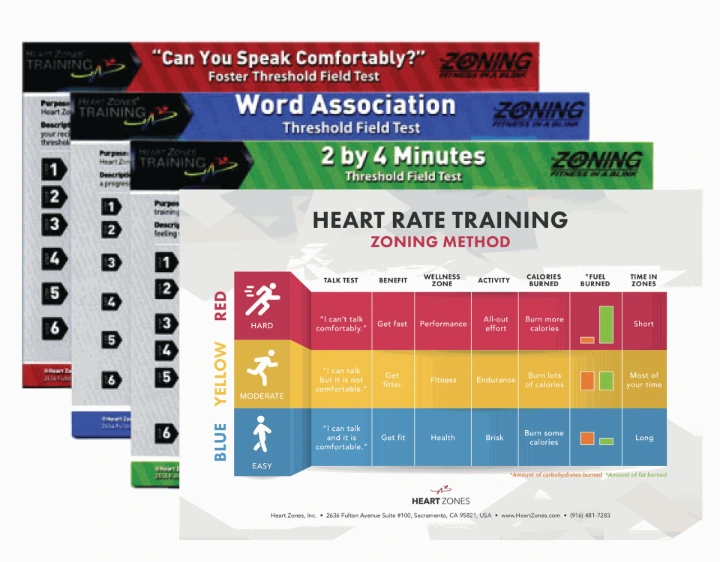
These early sub-max field tests did not require an often expensive lab treadmill or cycle ergometer just you and your heart rate monitor. The 10 different field tests was an improvement over APMHR and a number of spin-off formulas which assumed you can apply formulas to physiological data acquisition. Wrong.
Period 4: The Multi-Functional Heart Rate Monitor 2000-2015
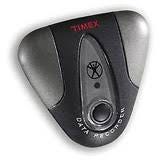
Moving into the new century, began the onslaught of manufacturing competition to Polar’s monopoly in the heart rate monitor business. Some of those competitors did not succeed but one of the most successful was Timex. At the time, Timex made some of the most popular watches marketed with their time-weathered slogan, “It takes a licking and keeps on ticking.” In 2003, Timex invented a key component that would later be integrated into most heart rate monitors, a third component - the Timex Data Recorder. It was cumbersome, time consuming, and challenging to connect all three wirelessly: the watch, the chest strap, and the data recorder. Having the real-time live data we needed during our workouts and races simultaneously becoming stored data was golden. The Timex Data Recorder provided us with a way to analyze the physical stress, time-in-zone from which training load is derived.
During this same era, the heart rate monitor further evolved into a multi-functional fitness and health tool, aka the early development of what today is called "lifestyle monitoring". This phase involved complex algorithms that were first developed by the Raleigh, North Carolina company Valencell in 2006. Valencell’s tech appeared in the first optical sensors, the Scosche Rhythm in 2014 followed by the Jabra Sport Pulse, the first earbuds with heart rate. This period was the introduction of the “sensor” versus the “monitor”. Today, as we live mostly in a world surrounded by sensors, heart rate became but one measurement. The explosion of sensors in biometric devices is about to change the health care industry.
Adding to this generation of bio-metrics devices in the early 2000’s was the integration of mechanical data such as steps tracking and cycling cadence using the built-in component, an accelerometer and in some cases a six-axis gyroscope for positioning. Around the same time these devices became known as “wearables”. Enter the fusion with GPS for geographical positioning, plus the use of optical sensors known as a PPG, photoplethysmography. For the first time, a chest strap was not required as the optical sensor using a green LED and companion algorithms provided accurate enough heart rate data. In 2014, the company Scosche partnered with the North Carolina company Valencell to manufacture the first commercially viable armband optical heart rate monitor - the Scosche Rhythm Plus.
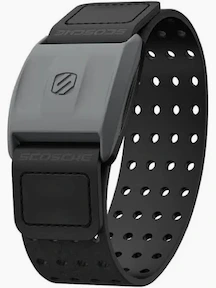
Now, finally without the deplorable chest strap, using a heart rate monitor became even more popular. With Apple and Garmin taking over the leading market position from Polar, the optical sensor led to a new functions of heart rate monitor training - to assess the user’s cardiac health. It is estimated that there are between 1.2 and 1.5 billion heart rate monitor devices in the world today with market data suggestion that 90% of these users actively use the heart rate monitor function.
In 2014, Heart Zones developed the first activity-based protocol to asses potential underlying cardiac irregularities, the “7 Healthy Heart Assessments to Save Lives” activity. This free assessment was a big jump forward in the application of heart rate data because for the first time heart rate monitors provided actionable assessment about self-care heart health. I recommend that you take this self-assessment as it becomes your personal baseline using a simple multi-functional heart rate monitor. Think ahead, like in ten years’ from today. If you take this assessment, store the data, retake this assessment every year, you will be able to quantify and record your personal trends from the effects of physiological change from aging process, from the long-term impact of stress, and from other changes to your physiology. Don’t just do it - use your heart rate monitor, snag the free how-to-do-it information and do your heart justice.